

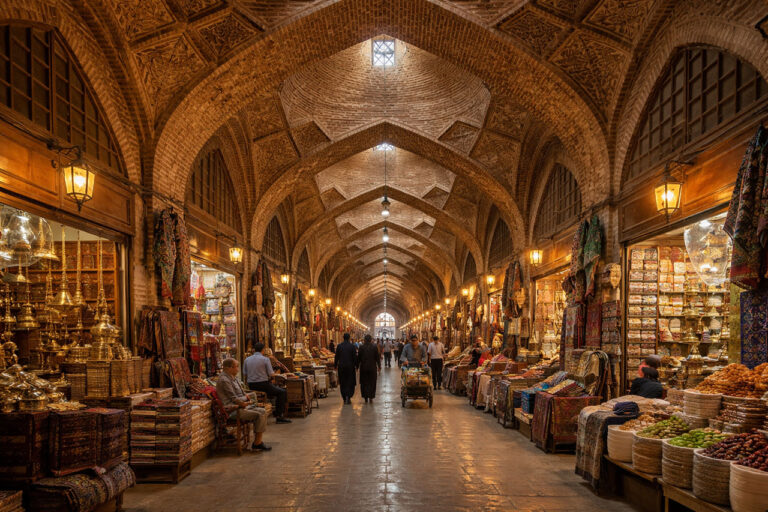
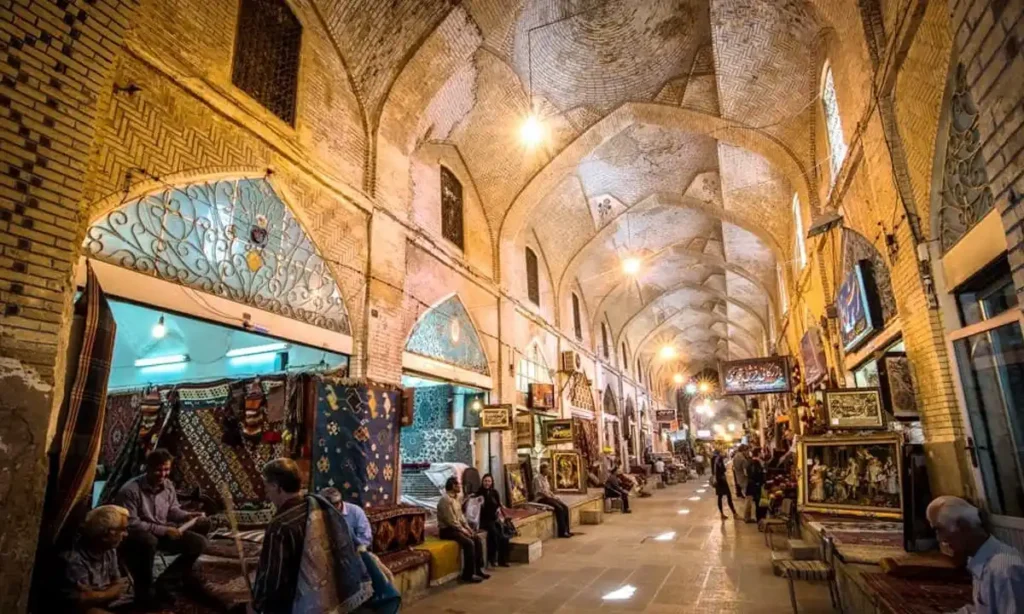
Vakil Bazaar in Shiraz is one of the most significant architectural landmarks of traditional Iranian urbanism. Constructed during the Zand dynasty in the 18th century under the patronage of Karim Khan Zand, the bazaar represents a highly sophisticated architectural response to climate, commerce, and social life. More than a marketplace, Vakil Bazaar is an integrated architectural system that reflects the intelligence and foresight of Persian architecture.
1. Urban Context and Architectural Significance
Vakil Bazaar occupies a central position within Shiraz’s historic urban fabric. Architecturally, it functions as a connective axis linking major civic and cultural buildings such as the Vakil Mosque, Vakil Bath, and the Arg of Karim Khan. This spatial integration illustrates how traditional Iranian architecture treated urban elements as interconnected components rather than isolated structures.
The bazaar’s placement reinforces its role not only as an economic hub but also as a social and cultural center.
2. Spatial Organization and Architectural Layout
The architectural structure of Vakil Bazaar is defined by long, linear corridors known as rastehs, intersecting at strategic points to form nodes of activity. These intersections enhance spatial orientation and create natural gathering areas within the marketplace.
Key architectural characteristics include:
Modular shop units that create rhythmic repetition
Clear circulation paths supporting efficient movement
Hierarchical spatial organization balancing openness and enclosure
This layout reflects a deep understanding of human behavior and functional architecture.
3. Structural System: Vaults and Arches
One of the most remarkable architectural features of Vakil Bazaar is its vaulted roof system. Brick vaults and arches span wide corridors, providing both structural integrity and spatial continuity.
These vaults serve multiple architectural functions:
Distributing structural loads efficiently
Allowing controlled daylight through roof openings
Facilitating natural ventilation
The structural system demonstrates the advanced engineering knowledge embedded within traditional Persian architecture.
4. Climate-Responsive Architectural Design
Vakil Bazaar exemplifies climate-responsive architecture long before the emergence of modern sustainability concepts. Thick masonry walls, high ceilings, and shaded corridors help regulate interior temperatures throughout the year.
Small openings at the apex of the vaults allow warm air to escape while bringing in diffused natural light. This passive environmental strategy creates a comfortable indoor climate without mechanical systems, highlighting the architectural wisdom of its time.
5. Materiality and Architectural Expression
The restrained use of materials—primarily brick, stone, and lime mortar—contributes to the bazaar’s durability and timeless aesthetic. Architectural expression is achieved through proportion, rhythm, and repetition rather than ornamentation.
This material honesty reflects a core principle of Persian architecture: architectural beauty emerges from structure, function, and proportion.
6. Architecture as a Social Framework
Beyond its physical form, Vakil Bazaar serves as a social framework shaped by architecture. Its human-scale proportions, shaded walkways, and spatial clarity encourage interaction, commerce, and communal life.
The architecture supports not only economic exchange but also cultural continuity, making the bazaar a living urban space rather than a static monument.
Conclusion: Contemporary Reflections by Ribo Architecture Studio
Vakil Bazaar in Shiraz remains a timeless architectural reference, demonstrating how architecture can respond holistically to climate, culture, economy, and urban structure. Its spatial intelligence, structural clarity, and environmental sensitivity continue to inspire architects seeking meaningful and resilient design solutions.
Drawing inspiration from such enduring architectural principles, Ribo Architecture Studio integrates cultural awareness, climatic responsiveness, and human-centered design into contemporary architectural practice. By reinterpreting traditional values through modern design strategies, Ribo Architecture Studio creates projects that respect context, enhance user experience, and contribute thoughtfully to today’s urban environments. The studio’s work reflects a belief that architecture, when rooted in identity and purpose, can achieve both timelessness and relevance.
No comments yet.