


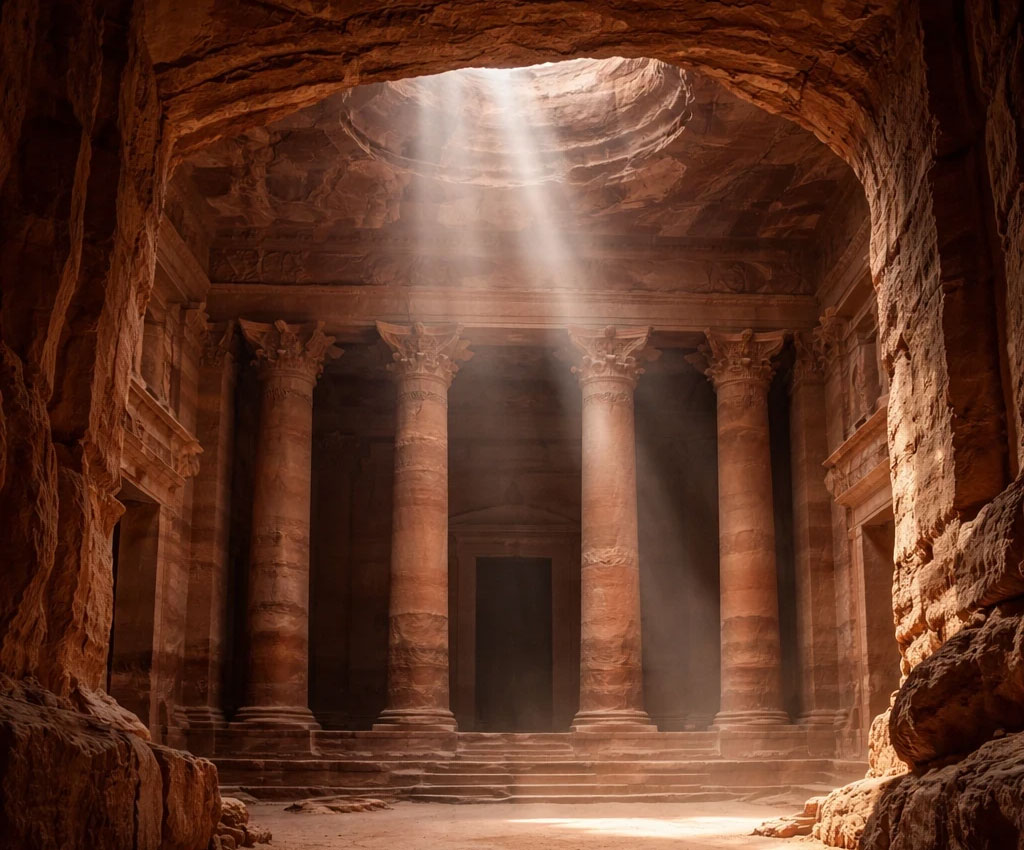
Petra, located in southern Jordan, is one of the most remarkable examples of ancient architecture in the world. Known as the “Rose-Red City”, Petra was carved directly into sandstone cliffs, creating a unique fusion of natural landscape and human craftsmanship.
Recognized as a UNESCO World Heritage Site in 1985 and named one of the New Seven Wonders of the World in 2007, Petra stands as a timeless reference for architects, designers, and urban planners worldwide.
1. Historical Background of Petra
Petra was established around the 4th century BCE as the capital of the Nabataean Kingdom. Thanks to its strategic location along major trade routes, the city became a vital commercial and cultural center connecting Arabia, Egypt, and the Mediterranean.
Key trade goods included:
- Frankincense and myrrh
- Spices and luxury textiles
- Precious stones and metals
Over time, shifting trade routes and powerful earthquakes led to Petra’s decline, leaving the city abandoned and hidden for centuries until its rediscovery in 1812.
2. Rock-Cut Architecture as a Design Philosophy
What defines Petra’s architectural identity is its extraordinary rock-cut architecture. Entire buildings—temples, tombs, and public spaces—were sculpted directly from the mountain itself, eliminating the need for conventional construction materials.
The iconic Al-Khazneh (The Treasury) reflects:
- Classical proportions and columns
- Nabataean symbolism
- Strong Hellenistic and Roman architectural influences
This synthesis of cultures makes Petra one of the most influential architectural landmarks in history.
3. Urban Planning and Engineering Innovation
Petra was not only monumental in appearance but also highly advanced in urban design:
- Sophisticated water management systems with dams, channels, and cisterns
- Streets and public spaces adapted to natural topography
- Passive climate control through orientation, shading, and thermal mass
These strategies allowed Petra to function as a sustainable city in a harsh desert climate.
4. Petra as an Early Model of Sustainable Architecture
From a contemporary architectural perspective, Petra represents an early form of sustainable and climate-responsive architecture:
- Minimal intervention in the natural landscape
- Use of local materials with zero transportation impact
- Passive cooling and natural daylighting
- Efficient water harvesting and storage systems
Many principles of modern sustainable architecture can be traced back to Petra’s intelligent design solutions.
5. Cultural and Symbolic Value in Architecture
Beyond its physical form, Petra holds deep cultural and architectural significance:
- A symbol of human adaptability and innovation
- A meeting point of Eastern and Western architectural traditions
- A powerful example of architecture shaped by geography and climate
Petra also reminds us of the importance of architectural heritage preservation in the face of erosion and mass tourism.
6. Influence of Petra on Contemporary Architecture
Today, Petra continues to inspire architects in areas such as:
- Context-driven architectural design
- Landscape-integrated architecture
- Monumentality achieved through form, not excess
- Respectful dialogue between built space and nature
Petra proves that enduring architecture does not dominate its environment—it emerges from it.
Conclusion | Petra Through the Vision of Ribo Architecture Studio
At Ribo Architecture Studio, Petra is more than an ancient city—it is a timeless architectural lesson. It demonstrates how architecture can grow from context, climate, and culture rather than imposed trends.
Inspired by masterpieces like Petra, Ribo Architecture Studio approaches every project with:
- Deep respect for site and surroundings
- A strong commitment to sustainable architecture
- A focus on creating meaningful, long-lasting spaces
We believe that great architecture is not defined by scale or style, but by its ability to connect people, place, and time.
📐 Architecture is not merely built—it is revealed.
— Ribo Architecture Studio
No comments yet.