

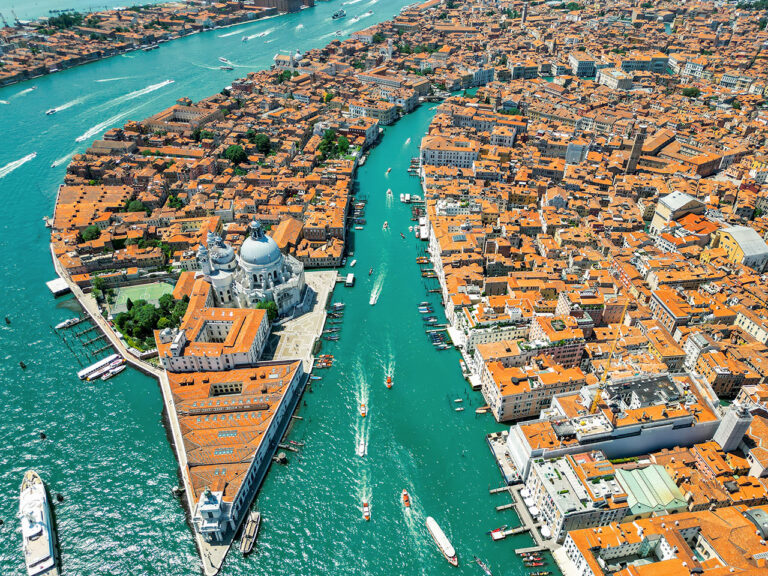

Doge’s Palace, or Palazzo Ducale, is one of Venice’s most iconic landmarks, symbolizing the power and history of the Venetian Republic. Its origins date back to the 9th century, when a fortified residence stood on the site. Over the centuries, the palace evolved through multiple reconstructions, reflecting the city’s political, cultural, and architectural transformations.
The current structure largely dates from the 14th and 15th centuries, showcasing Venetian Gothic architecture. A later Renaissance wing was added along the canal side between the late 15th and mid-16th centuries, housing the Doge’s private apartments and government offices. Each layer of construction contributes to the palace’s unique architectural tapestry, blending Gothic, Renaissance, and Baroque elements.
Architectural Highlights
Doge’s Palace is a three-part complex arranged around a central courtyard. Its Venetian Gothic style is characterized by:
Delicate Loggias: Open arched colonnades on the lower floors, constructed in Istrian stone.
Patterned Marble Façades: Pink and white marble creates a striking visual effect across the upper stories.
The Golden Staircase (Scala d’Oro): A grand staircase adorned with gilded stucco and frescoes, connecting the lower floors to the Doge’s apartments.
Opulent Interiors: Lavish frescoes, paintings, and carvings decorate the palace halls, illustrating the wealth and sophistication of Venice’s ruling elite.
The palace seamlessly combines aesthetic beauty with functional design, accommodating governance, justice, and ceremonial needs.
Decline and Adaptive Reuse
Throughout its history, Doge’s Palace served multiple essential roles:
Residence of the Doge: The elected leader of the Venetian Republic lived in the palace, with private apartments connected to state halls.
Political Center: Government councils, legislative chambers, and administrative offices were located here, making it the heart of Venice’s decision-making.
Judicial Hub: The palace housed courtrooms and prison cells, later connected to the famous Bridge of Sighs.
As the center of Venice’s political and judicial power, the palace reflected the city’s influence as a maritime and commercial empire.
Decline and Adaptive Reuse
After the fall of the Venetian Republic in 1797, the palace lost its original political function. Under French and Austrian rule, parts of the building were repurposed for administrative and cultural uses, including housing the city’s historic library.
By the late 19th century, restoration efforts were necessary to preserve its historical and architectural value. Today, Doge’s Palace functions as a museum, offering visitors a chance to explore Venice’s rich history while maintaining the integrity of its centuries-old architecture.
Cultural and Architectural Significance
Doge’s Palace is more than just a historic building; it is a testament to Venice’s legacy:
Historical Preservation: Restoration has maintained original Gothic and Renaissance features, keeping the city’s heritage alive.
Tourism and Education: As a museum, it educates visitors on Venetian history, art, and governance.
Architectural Inspiration: Its combination of grandeur and functionality continues to influence architects and designers worldwide.
Conclusion: history, art, and architecture
Doge’s Palace exemplifies the intersection of history, art, and architecture. From a seat of political power to a modern museum, the palace has adapted over centuries while preserving its identity. Today, it remains a symbol of Venice’s cultural wealth and architectural brilliance—a living testament to the city’s past and a bridge to its future.
About Ribo Architecture Studio
At Ribo Architecture Studio, adaptive reuse is more than a design strategy—it is a philosophy. The studio approaches each project with a deep respect for the existing structure, studying its history and crafting innovative interior solutions that balance functionality with heritage preservation.
Ribo Architecture Studio focuses on:
Preserving architectural character
Enhancing spatial functionality
Integrating sustainable design principles
Creating interiors that harmonize beauty, emotion, and practicality
Through projects like historic palaces, cultural landmarks, and heritage buildings, Ribo Architecture Studio ensures that old spaces are thoughtfully transformed into meaningful, modern environments for future generations.
No comments yet.