

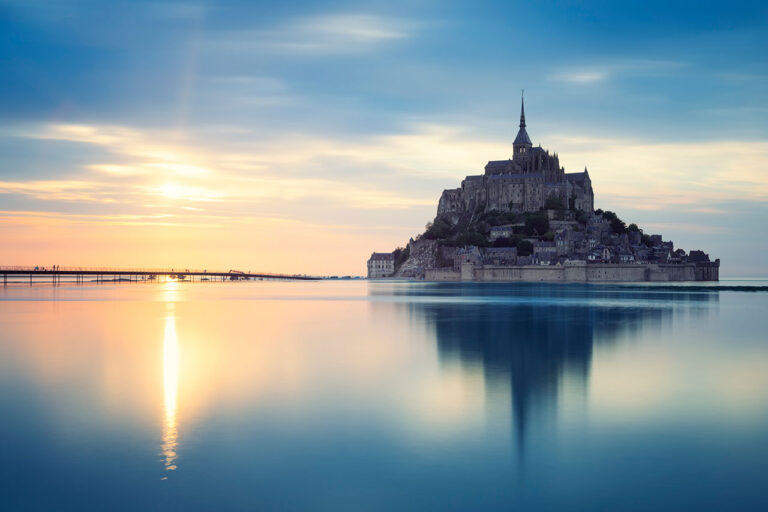
Located on the edge of Normandy in north‑western France, Mont Saint‑Michel is one of Europe’s most iconic landmarks — both for its dramatic setting and rich history. This rocky tidal island rises sharply from the surrounding bay, crowned by an impressive medieval abbey that has drawn pilgrims, scholars, and travelers for centuries
1. A Fortress in the Tides
Mont Saint‑Michel is a nearly circular granite islet about 900 meters in circumference, rising to 78 meters above the bay. Most of the time it is surrounded by vast sandbanks and, when the tide is high, becomes an island separated from the mainland by water. Its tidal range is among the largest in Europe, with the sea sometimes rushing in so quickly it isolates the mount within minutes.
Before modern causeways were built to connect it to the mainland, reaching Mont Saint‑Michel was notoriously difficult due to quicksand and rapidly rising tides — adding to its mystique and defensive advantage.
2. Origins and Religious Significance
Originally known as Mont‑Tombe, the site became known as Mont Saint‑Michel in the 8th century after St. Aubert, the bishop of Avranches, reportedly had a vision of the Archangel Michael commanding him to build an oratory there. Over time, the site became a major center of pilgrimage throughout medieval Europe.
In 966, a Benedictine abbey was established on the mount, laying the foundation for centuries of religious importance and architectural development. The abbey’s construction continued into the 12th and 13th centuries, producing structures that combine military strength with spiritual purpose.
3. Architectural Highlights
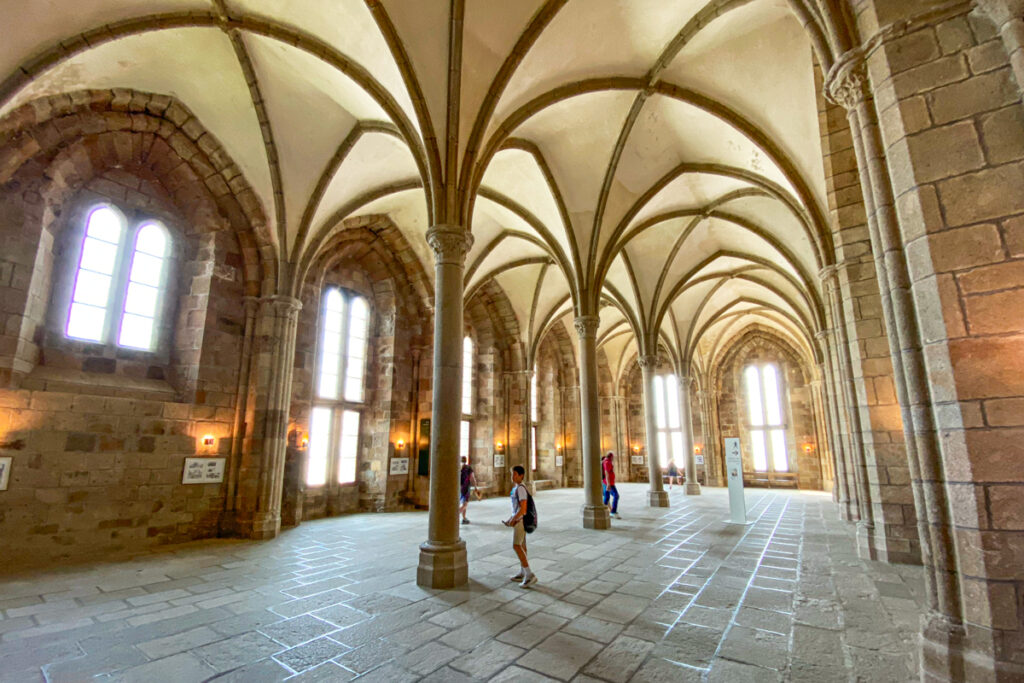
The Abbey of Mont Saint‑Michel is a masterpiece of medieval architecture, blending Romanesque and Gothic styles. It was constructed over several centuries, with the earliest sections dating from the 11th century and later Gothic additions completed in the 15th century. A tall spire topped with a statue of St. Michael rises above the complex, symbolizing heavenly ascent.
The abbey’s layout was designed to reflect the social and spiritual hierarchy of the medieval world: from the practical housing and workshops at the base, through monastic halls and cloisters, up to the sacred spaces at the top.
Surrounding the abbey, narrow winding streets date back to the 15th century. Many of these medieval houses today house tourist shops, cafés, and boutique hotels, creating a vibrant contrast between historical architecture and contemporary tourism.
4. A UNESCO World Heritage Treasure
Mont Saint‑Michel and its bay were inscribed as a UNESCO World Heritage Site in 1979. This designation recognizes both the outstanding universal value of its architectural legacy and the natural beauty of its tidal environment.
In addition to its medieval heritage, the site has undergone various historical phases — including use as a state prison during the French Revolution and the Napoleonic era — before restoration efforts in the 19th century helped preserve its historical character.
5. Visiting Mont Saint‑Michel Today
Mont Saint‑Michel remains one of the most visited cultural sites in France. It is freely accessible year‑round, and visitors often explore the causeway bridge, medieval ramparts, and abbey interiors. The best times to visit are early morning or late afternoon, when the light is strongest and the crowds are smaller.
The physical phenomenon of the rising tide is a major draw. Arriving several hours before high tide allows visitors to see the sea surround the mount, a truly breathtaking sight.
Conclusion: A Symbol of Nature and Human Endeavor
Mont Saint‑Michel stands as a powerful synthesis of natural wonder and human achievement — a place where geology, tides, medieval faith, and architectural ingenuity converge. Its abbey remains a testament to centuries of craftsmanship, while its dramatic setting continues to inspire awe among visitors from around the world.
From its rugged granite base to its soaring spire, Mont Saint‑Michel captures the imagination as much today as it did for pilgrims centuries ago — a true jewel of French heritage.
No comments yet.