

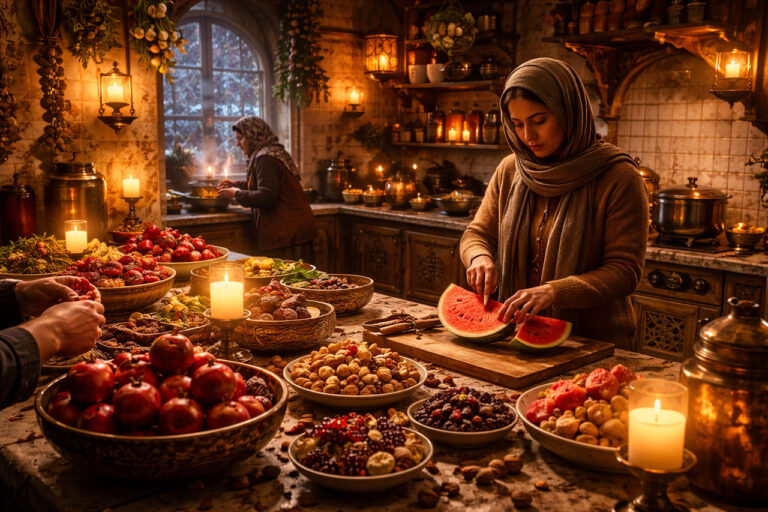
Yalda Night, the longest night of the year, is one of the most meaningful cultural celebrations in Iranian tradition. While it is commonly associated with poetry, family gatherings, and seasonal symbolism, Yalda Night also holds a deep and often overlooked connection to architecture. From traditional Iranian houses to contemporary interior design, architecture has always played a vital role in shaping how Yalda is experienced.
By examining Yalda Night through an architectural lens, we can better understand how cultural rituals influence spatial organization, lighting, material choices, and human-centered design.
1. Architecture as the Cultural Setting of Yalda Night
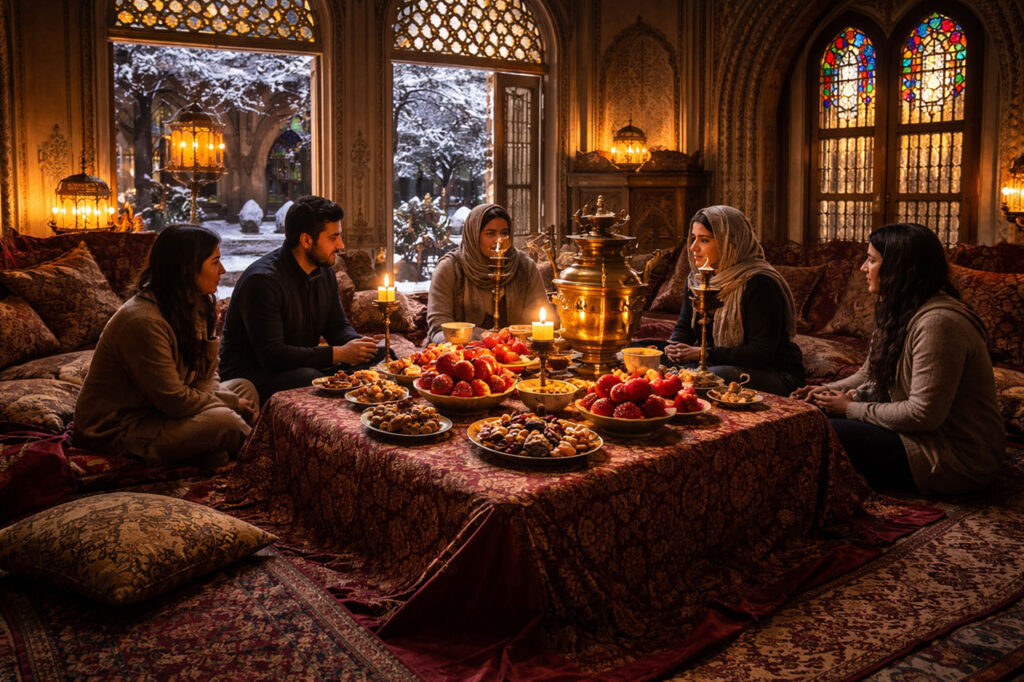
Traditionally, Yalda Night is celebrated indoors, within warm and intimate architectural spaces. As a result, Iranian residential architecture evolved to support collective gatherings during cold seasons.
Key architectural features include:
Central living rooms designed for family gatherings
Low seating arrangements that encourage closeness
Thick walls and compact openings for thermal comfort
Spatial layouts centered around warmth and protection
Because of this, architecture does not merely host Yalda Night—it actively supports social connection and emotional comfort.
2. Light and Darkness: A Core Architectural Concept
Yalda Night symbolizes the victory of light over darkness. Interestingly, this theme directly aligns with one of architecture’s fundamental concerns: the control of light.
Architectural connections include:
The contrast between enclosed, dim interiors and warm artificial light
The symbolic use of candles, fire, and soft lighting
The gradual transition from darkness to daylight after Yalda
Therefore, architecture becomes a physical expression of Yalda’s symbolic meaning, transforming light into a spatial experience.
3. Architecture as a Space for Storytelling and Memory
Yalda Night is deeply rooted in storytelling, poetry reading (especially Hafez), and shared memories. Architecture shapes these experiences by providing:
Proper acoustics for conversation and poetry
Enclosed and intimate spaces for collective attention
Circular or inward-facing seating layouts
In this way, architecture enables cultural continuity. Without appropriate spatial design, these rituals would lose their emotional depth.
4. Seasonal and Climate-Responsive Architecture
Yalda marks the beginning of winter, which historically influenced architectural responses to climate. Traditional Iranian architecture adapted to seasonal changes by:
Using winter-oriented living spaces
Minimizing heat loss through compact design
Selecting materials that retain warmth
As a result, Yalda Night became part of a broader seasonally responsive architectural lifestyle, rather than a single event.
5. Yalda-Inspired Ideas in Contemporary Architecture
Today, architects reinterpret Yalda concepts in modern design through:
Warm material palettes
Soft, layered lighting strategies
Open-plan gathering spaces
Human-centered interior layouts
These design approaches demonstrate how cultural rituals continue to inspire contemporary architecture without direct imitation.
Conclusion: Culture Lives Through Architecture
Yalda Night is more than a cultural celebration—it is a reflection of how humans relate to space, time, and one another. Architecture acts as the silent framework that allows warmth, gathering, storytelling, and light to come together in meaningful ways. By shaping how people experience Yalda, architecture preserves cultural identity across generations.
In this context, Ribo Architecture Studio approaches architecture as a cultural and human-centered discipline. By studying seasonal behavior, cultural rituals, and social patterns, the studio designs spaces that go beyond form and function. Ribo Architecture Studio creates environments where architecture supports connection, emotional comfort, and collective experience—values that closely align with the spirit of Yalda Night. Through thoughtful use of light, materials, and spatial hierarchy, the studio ensures that architecture remains a living bridge between tradition and contemporary life.
No comments yet.